

According to data from Italy’s National Institute of Statistics (ISTAT), the life expectancy of a 65-year-old in Italy has risen by more than 20 additional years, and over 21% of the population has already surpassed this age threshold. A significant number of older adults—more than 2.8 million people—live with limitations that prevent them from being fully self-sufficient, a challenge that affects not only those directly involved but also their families. By 2050, it is estimated that approximately one-third of the Italian population will be over the age of 65, making it fundamental to identify solutions to address the economic and social challenges that lie ahead.
The growing share of the population in later life creates interesting opportunities for the silver economy, but it also raises many questions about the healthcare system’s ability to meet the needs of older adults and their caregivers. For this reason, in October 2025 we investigated public sentiment regarding some of these issues.
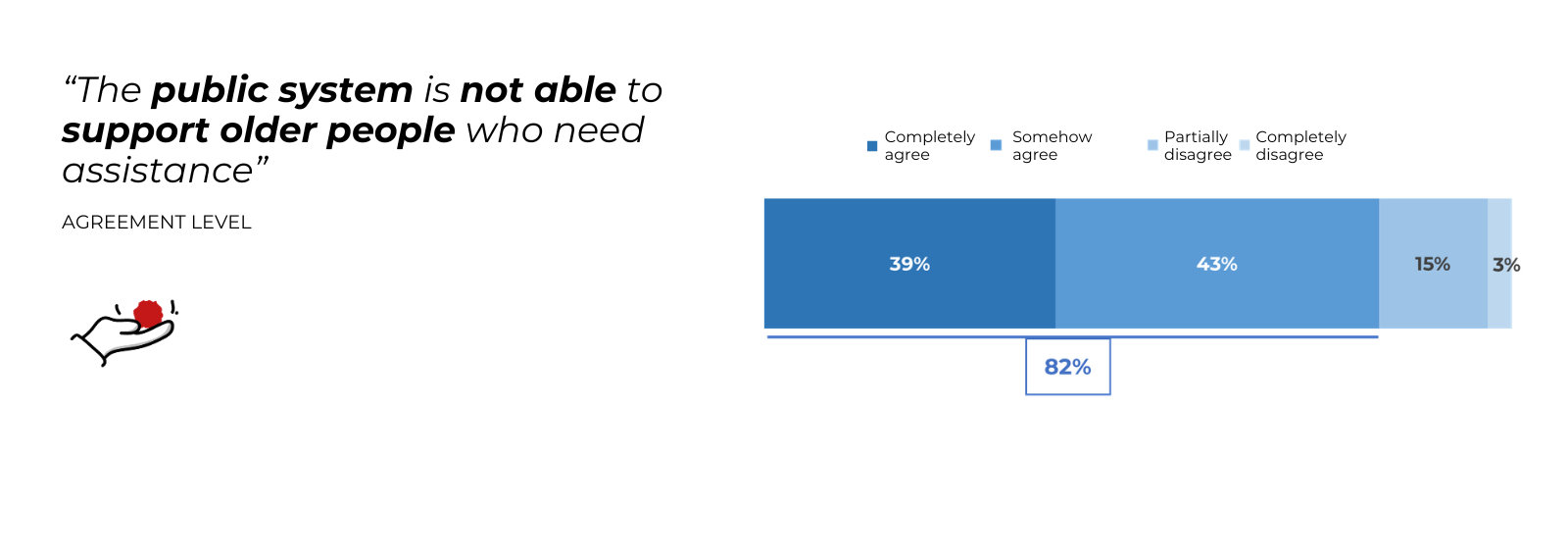
What we discovered first and foremost was a widespread sense of distrust toward the system that is expected to provide the necessary support during old age. More than 80% of respondents agreed or strongly agreed with the statement that the State (and the public system in general) will not be able to take care of them in the years to come. This perception is consistent across all age groups.
In addition, there is a widespread uncertainty about the financial ability of family members to meet the needs of elderly relatives. In this case, the concern is particularly evident among two broad age groups:
- Those who are themselves approaching older age (40% among respondents aged 65–74).
- Those who may currently be caring for older relatives and therefore have a direct understanding of the challenges they themselves could face in the future (particularly among respondents aged 35–54).
As a result, there is growing attention (and concern) among adults regarding the management of old age and its potential impact on their own future ability to cope, as well as on that of their children.
This raises an important question: is it time to begin designing and implementing new forms of public-private collaboration to address the ongoing trend of ageing population?
These findings are also available in the dedicated report on the topic, which can be downloaded at the following link: Longevity Report (in Italian).